
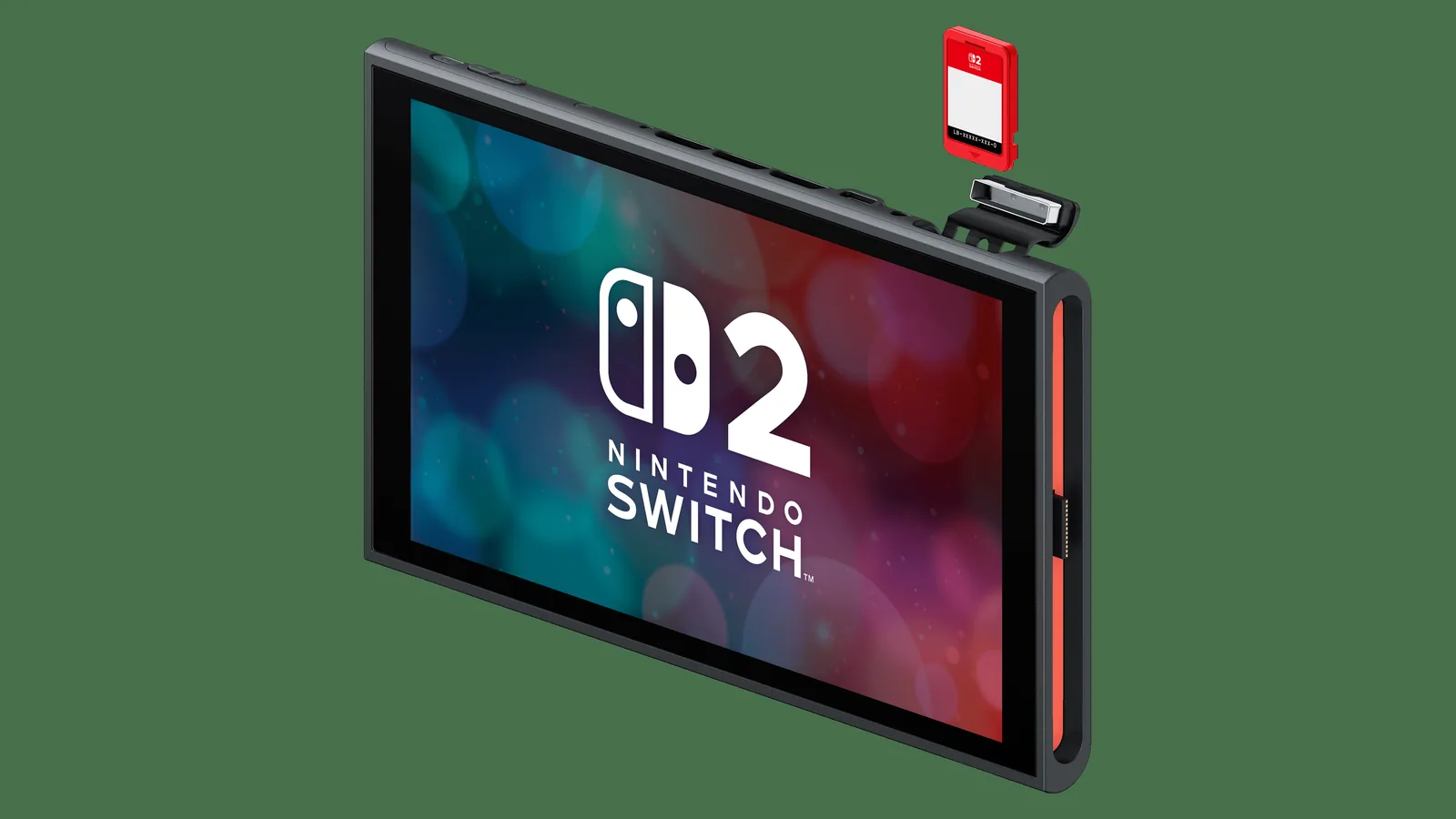
Nintendo has officially confirmed that the Nintendo Switch 2 will play original Switch games, while architectural documentation and developer leaks reveal custom Nintendo Switch 2 T239 silicon designed to modernize handheld gaming. The next console is not an impossible portable PS5 drawing hundreds of watts. Instead, it is an efficient hybrid machine with 1,536 Ampere graphics cores and 12 GB of fast memory. AI-driven DLSS upscaling delivers sharp 1080p handheld and 4K docked visuals within a strict portable power budget.
- Official backward compatibility: Nintendo President Shuntaro Furukawa confirmed during the Corporate Management Policy Briefing that Nintendo Switch software and Nintendo Switch Online will carry over to the successor console.
- Custom Nvidia T239 silicon: Developed under the internal codename Drake, the processor features an 8-core ARM Cortex-A78C CPU and a custom Ampere GPU with 1,536 CUDA cores and dedicated Tensor hardware.
- DLSS reconstruction over brute force: Hardware Tensor cores power Nvidia DLSS Super Resolution, allowing the console to reconstruct 1080p portable and 4K docked output without the battery drain of native high-resolution rendering.
- 12 GB LPDDR5X memory pool: Triples the original Switch memory footprint to 12 GB across a 128-bit bus. It delivers up to 102 GB/s of bandwidth docked and 68 GB/s in portable play.
- Realistic 15W to 30W thermal envelope: Handheld battery constraints keep raw compute near an optimized PS4 Pro or Steam Deck, but modern Ampere features and AI upscaling punch well above older rasterized hardware.
What Nintendo Switch 2 T239 silicon actually changes
The most important upgrade in the Nintendo Switch 2 is not the 4K logo on the packaging. It is the silicon inside the casing. Nintendo's official documentation describes the system processor as a custom processor made by Nvidia, while upstream Linux kernel driver patches confirm the silicon family as the Tegra T239.
That architectural shift is massive. The original 2017 Switch relied on Nvidia's Tegra X1, a mobile chip designed in 2015 on 20-nanometer Maxwell architecture. Over an eight-year lifespan, modern game engines outgrew those 256 aging CUDA cores. Developers spent years stripping geometry, cutting texture resolutions, and fighting frame pacing just to keep multi-platform titles running.
The T239 replaces that bottleneck with 1,536 Ampere CUDA cores and eight ARM Cortex-A78C CPU cores. That represents a six-fold increase in raw graphics hardware. More importantly, it brings modern instructions like mesh shading, hardware-accelerated decompression, and dedicated matrix math to a portable device.
Why DLSS matters more than raw teraflops
Console marketing cycles love to fixate on raw teraflops, but portable devices live and die by battery efficiency. Trying to run native 4K rendering on a 15-watt handheld battery is physically impossible. This reality is why Nvidia's Deep Learning Super Sampling is the centerpiece of the platform.
According to Nvidia technical architecture documentation, DLSS uses dedicated Tensor cores to analyze motion vectors, temporal buffers, and neural network weights. In handheld mode, a title can render internally at 720p or 1080p and reconstruct upward to match the native display with razor-sharp clarity. In TV mode, the console reconstructs to a 4K television without cooking the internal fan.
Crucially, the hardware focuses on DLSS Super Resolution rather than frame generation. Frame generation requires higher base framerates and specialized optical flow hardware that adds input latency and power draw to a portable console. For a hybrid system, spatial reconstruction delivers the exact efficiency boost Nintendo needs without compromising battery life.
12 GB LPDDR5X removes the porting bottleneck
For studios attempting to bring modern games to the original Switch, memory capacity was frequently a more brutal wall than GPU clocks. The 2017 Switch allocated just 4 GB of shared LPDDR4 memory, with nearly 1 GB reserved for the operating system. Squeezing complex game worlds into roughly 3 GB of usable memory forced severe compromises in texture resolution and asset streaming.
The Switch 2 solves this problem with 12 GB of LPDDR5X memory running across a 128-bit bus. According to hardware telemetry and component tracking, the memory subsystem delivers up to 102 GB/s of bandwidth docked and 68 GB/s in handheld mode. While slower than the high-power GDDR6 memory in home consoles, it is four times faster than the original Switch.
Think of memory bandwidth like a highway: the original Switch was a two-lane country road trying to handle rush-hour traffic. The new 102 GB/s memory pool gives modern game engines like Unreal Engine 5 the breathing room to stream textures and cache shaders without constant hitching.
The power budget keeps the hype honest
Internet rumors often describe the Switch 2 as a portable PlayStation 5, but that assumption ignores the laws of thermodynamics. A standard PS5 pulls between 180 and 220 watts from a wall socket, cooled by a massive heatsink and a heavy internal fan. A handheld machine must stay comfortable in your hands at 10W to 15W, and draw no more than 25W to 30W when docked.
In terms of raw compute, the T239 operates around 561 MHz portable and roughly 1,007 MHz docked. This yields approximately 1.7 teraflops of portable FP32 power and 3.1 teraflops docked. In pure rasterization, that places the GPU near an optimized PS4 Pro or Steam Deck.
However, judging modern silicon purely on teraflops is deceptive. Because the T239 incorporates Ampere Tensor cores, modern memory, and hardware ray tracing, it will run contemporary game engines far more cleanly than older fixed-function architectures ever could.
| Hardware Component | Original Switch (2017) | Switch 2 (T239) | What It Changes for Players |
|---|---|---|---|
| SoC & Architecture | Nvidia Tegra X1 (Maxwell 20nm/16nm, 256 CUDA cores) | Custom Nvidia T239 (Ampere, 1,536 CUDA cores) | Six-fold graphics increase with modern tensor hardware for denser, cleaner game worlds. |
| AI Upscaling | None (Bilinear / Spatial only) | Dedicated Tensor Cores (Nvidia DLSS) | Sharp 1080p handheld and up to 4K docked output without draining battery on native pixels. |
| Memory (RAM) | 4 GB LPDDR4 (25.6 GB/s) | 12 GB LPDDR5X (Up to 102 GB/s) | Triples memory capacity to handle modern engine asset streaming and high-resolution textures. |
| Internal Storage | 32 GB / 64 GB eMMC 5.1 | 256 GB UFS Storage (microSD Express expandable) | Drastically faster load times and four times the base game installation space. |
| Display & Output | 720p 60Hz LCD / 1080p 60Hz Docked | 1080p 120Hz HDR Panel / Up to 4K 60Hz Docked | Full HD handheld clarity with HDR contrast and high refresh rate support. |
| Backward Compatibility | N/A | Physical Switch & Switch 2 Game Cards + Digital Library | Preserves existing physical game cartridges and digital purchases through your Nintendo Account. |
Backward compatibility is physical, digital, and conditional
The cartridge question is simpler than the rumor cycle suggested. Official support documentation notes that both Switch 2 and original Switch game cards can be inserted directly into the console. Nintendo also confirms that the system plays compatible digital purchases.
The word compatible does real work here. According to Nintendo's compatibility guidelines, because the underlying hardware architecture is different, some legacy Switch software may require targeted compatibility patches or experience minor feature differences.
The physical library remains the real victory. Players with shelves of Switch game cards are not forced to start over. Backward compatibility acts as a stable bridge, protecting your investment while giving older games faster loading and more consistent frame rates.
What current Switch owners should check before buying
Upgrading to a new console generation is exciting, but hardware changes mean a few old habits will need adjusting. Here is what current Switch players should keep in mind before opening their wallets:
Your existing controllers: Original Joy-Con controllers can pair wirelessly for multiplayer games on the couch. However, they will not slide onto the Switch 2 console rails because the new system has different physical dimensions and magnetic attachments. If you own a Nintendo Switch Pro Controller, it transitions smoothly over Bluetooth.
Your memory cards: Older microSD cards cannot run Switch 2 games. The new system requires high-speed microSD Express cards for game installations. You can still use your old card to transfer screenshots and video captures, but you will need new storage for next-generation titles.
Your docks and chargers: Original Switch docks are completely incompatible with the new chassis. Your old AC adapter can charge the Switch 2 handheld directly when traveling, but it lacks the power output needed to drive 4K TV mode through the new dock.
The real generational leap
The Nintendo Switch 2 does not represent Nintendo chasing the raw horsepower arms race. The original Switch simply lasted far longer than a 2015 mobile processor ever should have. The new console equips developers with the tools modern games actually demand: AI reconstruction, an HDR display, faster UFS storage, and 12 GB of high-speed memory.
That balance makes the Switch 2 a formidable platform. It preserves the flexibility of hybrid play while removing the worst technical bottlenecks of the past eight years. If Nintendo delivers transparent compatibility and developers utilize DLSS intelligently, this upgrade will feel less like a dry spec-sheet bump and more like the moment the Switch concept finally caught up with modern gaming.
Frequently Asked Questions
Is the Nintendo Switch 2 backward compatible with original Switch games?
Yes. Nintendo has officially confirmed that both physical Switch game cards and digital Nintendo Account purchases will run on the successor console.
Will my original Joy-Con controllers attach to the Switch 2?
No. While older Joy-Cons can connect wirelessly for tabletop or docked multiplayer, they cannot physically attach to the Switch 2 rails due to updated chassis dimensions.
Does the Switch 2 support Nvidia DLSS?
Yes. The custom T239 processor features dedicated Tensor cores that run Nvidia DLSS Super Resolution to reconstruct 1080p handheld and up to 4K docked output.
What is the Nvidia Tegra T239?
The T239 is a custom system-on-chip manufactured by Nvidia for Nintendo. It combines eight ARM Cortex-A78C CPU cores with 1,536 Ampere graphics cores.


Reader Discussion